Traditional SEO assumed “rankings = blue links.” In reality, AI search systems—Google AI Overviews, Bing Copilot, ChatGPT Browse, Perplexity—now rank entities and sources, not just URLs. If those systems can’t reliably resolve queries to your brand, your content quietly disappears from answer boxes, knowledge panels, and conversational results. That’s where entity seo for ai search comes in.
Instead of chasing every keyword variation, you define your key entities (brand, products, people, concepts), connect them in a content knowledge graph, and express those relationships in schema, internal links, and off‑site profiles. When AI models build answers, your brand becomes a trusted node they can confidently cite.
In this guide, aimed at technical SEOs and content strategists, we’ll unpack how entities actually flow through AI search: knowledge graphs, schema markup, internal entity linking, and external corroboration. You’ll get a practical entity SEO audit checklist, implementation patterns for schema and content, and a measurement framework for tracking AI citations and answer share over time.
Why Entity SEO for AI Search Matters Now
AI search uses the web less like a list of pages and more like a graph of entities: brands, people, products, places, and concepts connected by relationships. Google’s Knowledge Graph alone has grown to hundreds of billions of facts on billions of entities, powering panels and instant answers across Search and Assistant.
Google’s own AI features and your website documentation notes there’s no secret “AI Overviews tag”—eligibility is based on the same indexing and snippet signals you already optimize for. [1] That means entity-based SEO for AI search isn’t about a new magic attribute; it’s about feeding those systems clean, unambiguous entity data at scale.
At the same time, research on SearchGPT shows that ~87% of ChatGPT’s citations align with Bing’s top organic results, especially positions 1–20. [3] In practice, that means AI answer citations lean heavily on traditional rankings plus entity clarity.
Done right, entity seo for ai search gives you:
- Higher odds of appearing in AI Overviews and answer boxes
- Stronger brand authority signals for AI search (E‑E‑A‑T + off‑site corroboration)
- More durable visibility as ranking systems evolve from strings to things
For technical SEOs, the shift is simple but profound: stop asking “Can I rank for this phrase?” and start asking “Will AI reliably resolve this phrase to our entity and content?”
Modeling Entities: Knowledge Graphs, Schema, and Links
What Counts as an Entity in SEO?
In search, an entity is any uniquely identifiable “thing”: a company, product, person, event, or abstract concept. “Apple” (keyword) could be fruit or the tech company; “Apple Inc.” (entity) is tied to Cupertino, Tim Cook, iPhone, and specific IDs in Wikidata.
Entity-first SEO strategies treat each canonical entity as a node with attributes (labels, descriptions, dates, categories) and relationships (ownedBy, competitorOf, locatedIn). That’s the foundation of a knowledge graph SEO strategy.
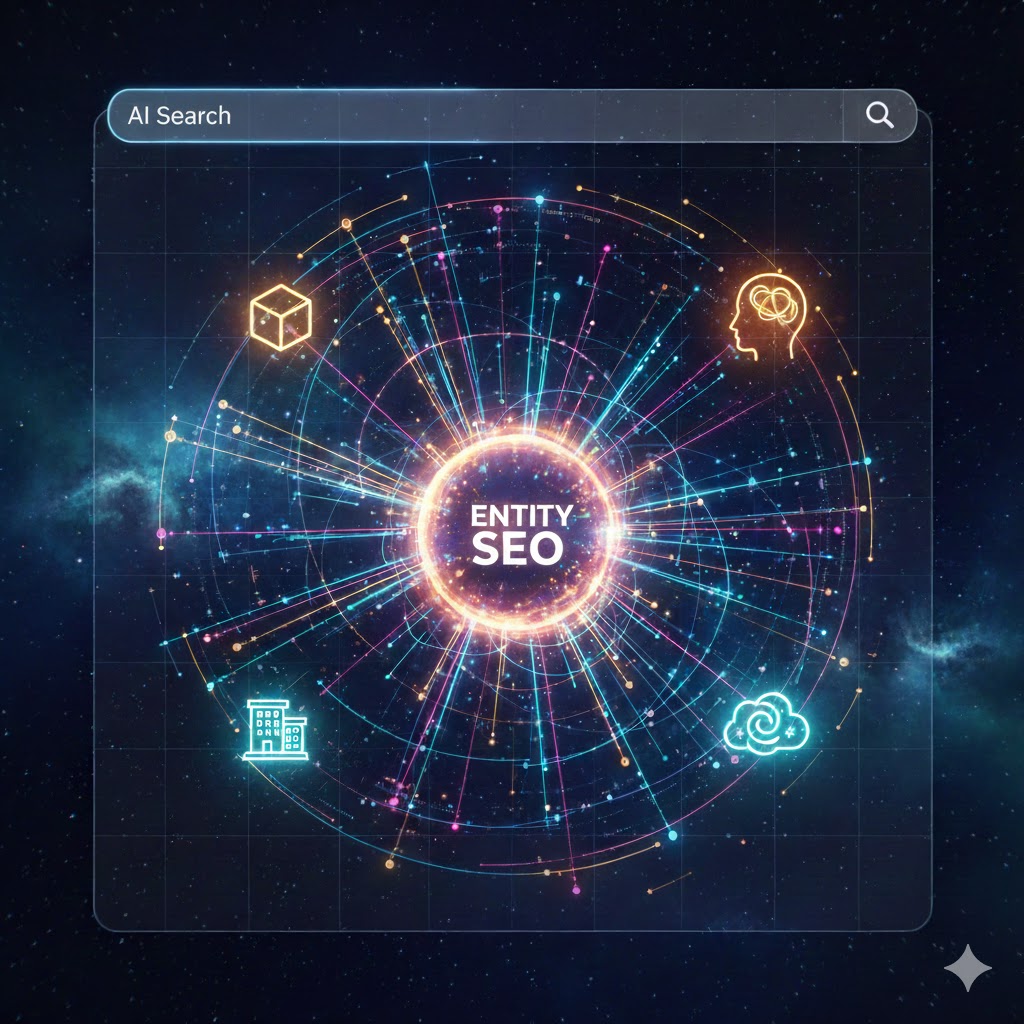
Knowledge Graphs, Embeddings, and AI Search
A knowledge graph ingests data from multiple sources, extracts entities, and connects them via relationships like owner of or located in. Graphs provide a machine-readable backbone that complements vector embeddings: graphs capture hard facts; embeddings capture fuzzy semantic similarity.
For AI search, that means:
- Knowledge Graph / entity store: who/what is this? what’s related?
- Embeddings / LLM: how should we phrase the answer? which passages are relevant?
If your content knowledge graph for SEO is thin or inconsistent, LLMs have less structured evidence to ground on—even if your prose is great.
Schema Markup Patterns that Disambiguate Entities
Schema isn’t just “SEO decoration”; it’s a serialization of your entity graph:
- Use @id to give every important entity (Organization, Product, Person, Service) a stable URI.
- Use mainEntityOfPage to declare the primary entity of an article or landing page.
- Use about to attach supporting entities (topics, audiences, tools).
- Use sameAs to connect your node to high‑trust profiles (Wikidata, LinkedIn, Crunchbase, Google Business Profile).
This is where schema markup for AI search overlaps with entity association SEO: your JSON‑LD tells AI systems exactly which “John Smith” and which “Acme Analytics” you mean.
Auditing and Implementing Entity SEO for AI Search
Step 1 – Inventory Your Entities, Attributes, and Aliases
Start your entity SEO audit checklist with a simple table:
- Core entities: brand, products, flagship content pillars, execs
- Attributes: names, descriptions, industries, categories, unique IDs
- Aliases: abbreviations, old brand names, common misspellings
Map each entity to one canonical URL and, ideally, one @id.
Step 2 – Internal Entity Linking Strategy and Topic Clusters
The top‑ranking guides heavily advocate topic clusters and hub‑and‑spoke architectures.
Your implementation for entity seo for ai search should:
- Build pillar pages for each core entity (e.g., “Entity SEO for AI Search” as a canonical hub).
- Create supporting content for attributes, use cases, and comparisons.
- Use internal links with entity-rich anchor text (“AI search answer engine optimization guide” rather than “click here”).
This becomes a living internal entity linking strategy: every link reinforces node → node relationships that Knowledge Graphs and LLMs can reuse.
Step 3 – External Corroboration and Entity Stacking
AI doesn’t trust your site alone. The strongest pages in the SERP consistently stress:
- Consistent NAP + org details across Google Business Profile, LinkedIn, Crunchbase, review sites
- PR, podcasts, and third‑party articles to establish brand authority signals for AI search
- “Entity stacking”: interlinking org profiles, bios, press releases, and high‑authority citations
For entity seo for ai search, that means you deliberately create a web of references where your Organization, key People, and Products co‑occur on trusted domains—then bind those references back using schema sameAs.

Measuring and Iterating on Entity SEO for AI Search
Tracking AI Citations and Answer Visibility
If you treat AI search like “just more SERP features,” you’ll miss the point. Your measurement model should bifurcate:
- Classical search – rankings, traffic, CTR, rich results
- AI environments – citations and answer presence
Recent work on SearchGPT shows that almost all citations come from Bing’s organic results, with 87% mapping to the top 20 positions. Practically, that means your entity SEO for ChatGPT and Bing Copilot should watch Bing as closely as Google.
Track, at query or topic level:
- Citation count by engine (AI Overviews, Copilot, Perplexity, etc.)
- Share of answers where your brand is mentioned vs competitors
- Prominence: are you the primary cited entity or just one of many?
SERP + AI Search KPIs and Prioritization
For each entity or topic cluster, roll up:
- Organic KPIs: impressions, clicks, rankings, rich result share
- AI search SEO KPIs: AI Overview inclusion, answer engine citations, Knowledge Panel presence
- Health signals: schema coverage, crawl/index status, entity salience (via NLP APIs/tools)
Prioritize work where:
- You have strong organic rankings but zero AI citations (fix entities/schema).
- You’re cited often but rank poorly (improve on‑page and authority).
- Competitors outrank and out‑cite you on the same entity set.
Entity seo for ai search becomes an iterative loop: audit → implement → measure → refine.
Quick Takeaways
- AI search ranks entities and sources, not just pages.
- Strong entity SEO for AI search combines knowledge graphs, schema, and topic clusters.
- Use JSON‑LD to model entities (@id, mainEntityOfPage, about, sameAs).
- Build an internal entity linking strategy with entity‑rich anchors.
- Stack external profiles and citations to reinforce brand authority.
- Track AI citations and answer presence alongside traditional SERP KPIs.
- Iterate: re‑audit entities quarterly as your product and brand evolve.
Entity seo for ai search is less a new trick and more a re‑framing of everything you already do: information architecture, schema, internal links, and digital PR. The difference is that you now design them explicitly as inputs to AI systems that synthesize answers, not just rank lists of URLs.
By treating entities as first‑class objects—modeled in a content knowledge graph, serialized in schema, and corroborated across the wider web—you make it easy for AI search engines to understand who you are, what you do, and when to trust you. That translates directly into more consistent visibility in AI Overviews, ChatGPT/Bing Copilot answers, and knowledge panels, even as algorithms and interfaces shift.
For technical SEOs and content strategists, the playbook is clear: define your entities, wire them together with structured data and entity-first content, and measure your presence where AI is already borrowing your work. Start with one entity cluster, run the full audit → implementation → measurement loop, and expand from there until your brand is the obvious answer AI can’t ignore.
FAQs
Is entity SEO for AI search different from “normal” entity-based SEO?
Yes—same foundations, but the goal shifts from rankings alone to answer inclusion and citations across AI experiences.
Do I need special schema just for AI Overviews?
No. Google states AI features rely on standard indexing and snippet eligibility; focus on robust, accurate schema and high‑quality content.
How do I start an entity SEO audit checklist?
Inventory core entities, map canonical URLs and @ids, review schema coverage, internal entity links, and external profiles for consistency.
Which engines matter most for AI search answer engine optimization?
Today, Google (AI Overviews) and Bing are key; Bing is especially important for ChatGPT/ SearchGPT citations.
How long until entity SEO changes my AI visibility?
Expect gradual gains: weeks for crawl/index + schema adoption, months for consistent entity salience and AI citation improvements.