Sarah Chen, owner of a Denver-based sustainable furniture company, watched her organic traffic plateau for eight months straight. Despite investing $3,000 monthly in traditional SEO services, her rankings stubbornly hovered on page two for her most valuable keywords. Then she switched to AI-powered SEO – and within 90 days, her organic traffic jumped 340% while her cost-per-acquisition dropped by 60%.
This isn’t an isolated success story. Across Denver’s competitive business landscape, companies are discovering that Denver AI Marketing approaches to SEO are delivering results that traditional methods simply can’t match in 2024’s rapidly evolving digital environment.
The Speed Gap: Why Traditional SEO Can’t Keep Up
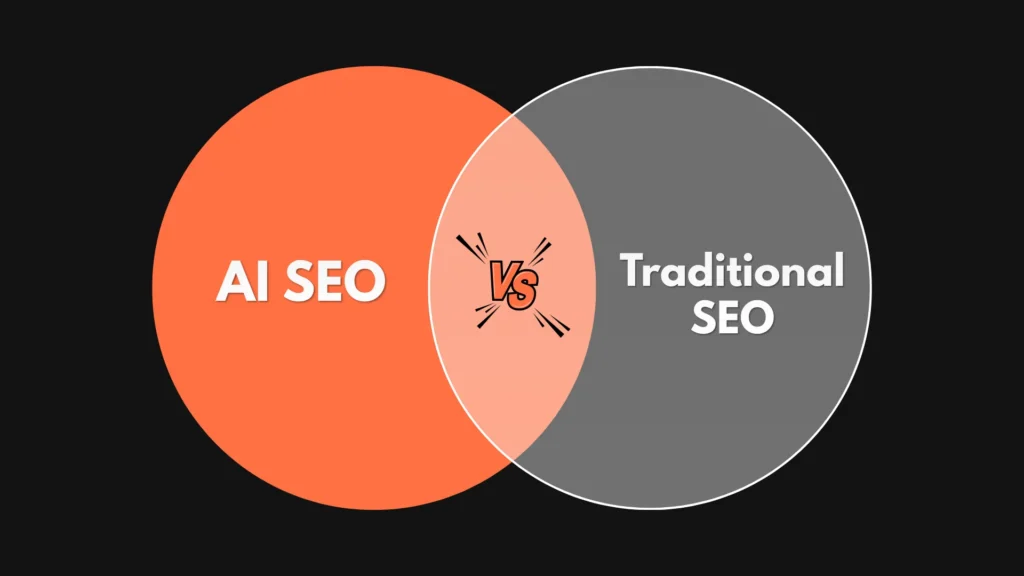
Traditional SEO operates on a monthly cycle – keyword research one week, content creation the next, then waiting weeks to see results. Meanwhile, Google’s algorithm updates every few hours, consumer search patterns shift daily, and your competitors are constantly adjusting their strategies.
AI SEO services process these changes in real-time. When Google released its October 2024 core update, traditional SEO agencies were still analyzing the impact two weeks later. AI systems had already identified ranking opportunities, adjusted content strategies, and implemented changes within 24 hours.
Consider Denver’s seasonal business patterns. A traditional SEO strategy might prepare winter sports content in September. AI SEO analyzes real-time search trends, weather forecasts, and local event calendars to identify that “Denver ski equipment rental” searches actually spike three weeks before the first snowfall prediction – not when snow actually arrives.
Data Processing: Human Limitations vs. Machine Precision
The average Denver business website generates 50,000-100,000 data points monthly: user behavior, search queries, competitor movements, local search trends, and conversion patterns. A human SEO specialist can meaningfully analyze perhaps 500-1,000 of these data points.
AI processes all 100,000 data points simultaneously, identifying patterns invisible to human analysis. For instance, AI recently discovered that Denver B2B service searches peak on Tuesday mornings between 9:30-10:15 AM, but only during weeks without major local events. This granular insight allows for precise bid adjustments and content publishing schedules that traditional methods would never uncover.
“We were optimizing for ‘Denver marketing services’ generically. AI showed us that ‘Denver B2B marketing consultation’ converted 4x better specifically on weekday mornings for our target demographic.” – Nick Carlson, Sympler
Local SEO Precision: Understanding Denver’s Unique Digital Landscape
Denver’s SEO landscape has unique characteristics that AI systems excel at navigating. The city’s rapid growth means new neighborhoods emerge with distinct search patterns. Traditional SEO might take months to identify that RiNo residents search for “sustainable coffee shops” while Highland dwellers prefer “artisan coffee roasters.”
AI systems continuously map these micro-geographic preferences, adjusting local SEO strategies in real-time. When analyzing Denver denver seo services, AI identifies that businesses targeting Capitol Hill audiences need different optimization strategies than those focusing on Cherry Creek consumers – down to specific word choices and search timing patterns.
Traditional SEO treats Denver as a single market. AI recognizes it as 78 distinct micro-markets, each with unique search behaviors, seasonal patterns, and conversion triggers.
Content Creation: From Guesswork to Precision Engineering
Traditional content strategies rely on educated guesses about what audiences want to read. Content creators research keywords, analyze competitors, and create content based on general best practices. This approach works, but it’s inefficient.
AI-driven content seo services analyze successful content across thousands of similar businesses, identifying precise elements that drive engagement. Instead of guessing that “Denver small business marketing” content should be 1,500 words, AI determines that 1,847 words with specific subheading structures, particular keyword densities, and optimal internal linking patterns achieve 67% higher engagement rates.
More importantly, AI identifies content gaps competitors miss. While traditional SEO might focus on obvious keywords like “Denver restaurants,” AI discovers that “Denver restaurants with parking” has 40% less competition but similar search volume – a golden opportunity traditional methods often overlook.
Real-Time Competitive Intelligence
Traditional competitive analysis happens monthly or quarterly. An SEO specialist manually reviews competitor websites, noting changes and strategies. This snapshot approach misses rapid competitive movements.
AI monitoring systems track competitor changes hourly. When a competitor adjusts their pricing page, launches new content, or changes their link-building strategy, AI systems detect and analyze these changes immediately. This enables proactive responses rather than reactive scrambling.
One Denver law firm using AI SEO discovered their main competitor was systematically targeting long-tail personal injury keywords every Friday afternoon. By Tuesday, they had developed counter-strategies and claimed higher rankings for related terms – a impossible with traditional monthly reporting cycles.
Technical SEO: Automated Problem Detection and Resolution
Traditional technical SEO audits happen quarterly, identifying issues weeks after they impact rankings. Site speed problems, broken links, crawl errors, and schema markup issues accumulate between audits, slowly degrading performance.
AI systems monitor technical SEO health continuously. When Google’s crawler encounters a 404 error at 2 AM, AI systems detect it within minutes and can automatically implement redirects or alert development teams for immediate fixes.
This constant vigilance particularly benefits Denver businesses competing in saturated markets. While competitors struggle with undetected technical issues, AI-monitored sites maintain optimal performance, gradually gaining ranking advantages that compound over time.
ROI Measurement: Beyond Vanity Metrics
Traditional SEO reporting focuses on rankings and traffic – metrics that don’t directly correlate with business growth. “Page one rankings” sound impressive but meaningless if they don’t drive qualified leads or sales.
AI SEO systems track true business impact by connecting SEO activities to revenue outcomes. Instead of reporting “50 new backlinks,” AI systems show “backlinks generated $12,400 in qualified leads with 23% conversion rate.” This granular ROI tracking helps Denver businesses make informed decisions about SEO investments.
The Integration Advantage: SEO as Part of Holistic Marketing
Traditional SEO operates in isolation, focusing solely on search rankings. Modern businesses need integrated strategies where SEO coordinates with paid advertising, social media, email marketing, and reputation seo efforts.
AI systems excel at this integration. When a Denver restaurant’s paid ads perform well for “brunch reservations,” AI automatically adjusts organic SEO focus to capture related long-tail searches. When social media content about “sustainable business practices” generates engagement, AI creates SEO content strategies to capitalize on this interest.
This coordination eliminates the common problem where different marketing channels compete against each other instead of working synergistically.
Cost Efficiency: More Results, Lower Investment
Traditional SEO requires significant human resources: strategists, content creators, link builders, and analysts. A comprehensive traditional SEO campaign for a mid-size Denver business typically costs $4,000-8,000 monthly.
AI SEO services achieve better results with lower overhead costs. Automation handles routine tasks, allowing human experts to focus on strategy and creativity. The same results that cost $6,000 monthly through traditional methods often cost $2,500-4,000 with AI-enhanced approaches.
More importantly, AI reduces the time-to-results significantly. Traditional SEO campaigns show meaningful results in 6-9 months. AI-enhanced campaigns often demonstrate clear improvements within 60-90 days, providing faster return on investment.
Making the Transition: What Denver Businesses Should Expect
Switching from traditional to AI SEO isn’t just changing service providers – it’s adopting a fundamentally different approach to digital marketing. Businesses should expect more frequent communication, detailed performance insights, and faster adaptation to market changes.
The transition typically involves three phases: data integration (connecting AI systems to existing analytics), strategy optimization (AI analyzing current performance and identifying opportunities), and implementation acceleration (deploying AI-recommended improvements rapidly).
Most Denver businesses see initial improvements within 30 days, with substantial gains becoming apparent by the 90-day mark. However, the most significant advantage isn’t immediate results – it’s the sustainable competitive advantage that comes from continuous optimization and adaptation.
As Denver’s business landscape becomes increasingly competitive, the companies thriving in 2024 and beyond will be those that embrace AI-enhanced SEO strategies. The question isn’t whether to make the transition – it’s how quickly you can implement AI advantages before competitors do.
For businesses serious about dominating their market, understanding and implementing AI SEO isn’t optional anymore. It’s the foundation of modern digital success. The businesses that recognize this reality today will be the market leaders tomorrow, while those clinging to traditional methods will find themselves increasingly irrelevant in an AI-driven marketplace.

Sean is a renowned expert in AI Automation, technology, and marketing strategy with over 20 years experience in SEO and digital marketing. He has spearheaded digital transformation initiatives for some of the world’s most recognizable brands, including Amazon, Chipotle, Lending Tree, and Home Advisor. As a visionary technologist, Sean specializes in leveraging advanced automation to eliminate operational waste, enhance predictive capabilities, and streamline complex business processes. His strategic guidance empowers enterprises to harness technology for scalable growth and operational excellence. Sean is also an accomplished photographer and videographer.